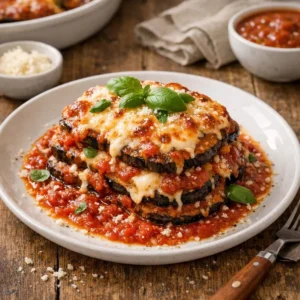
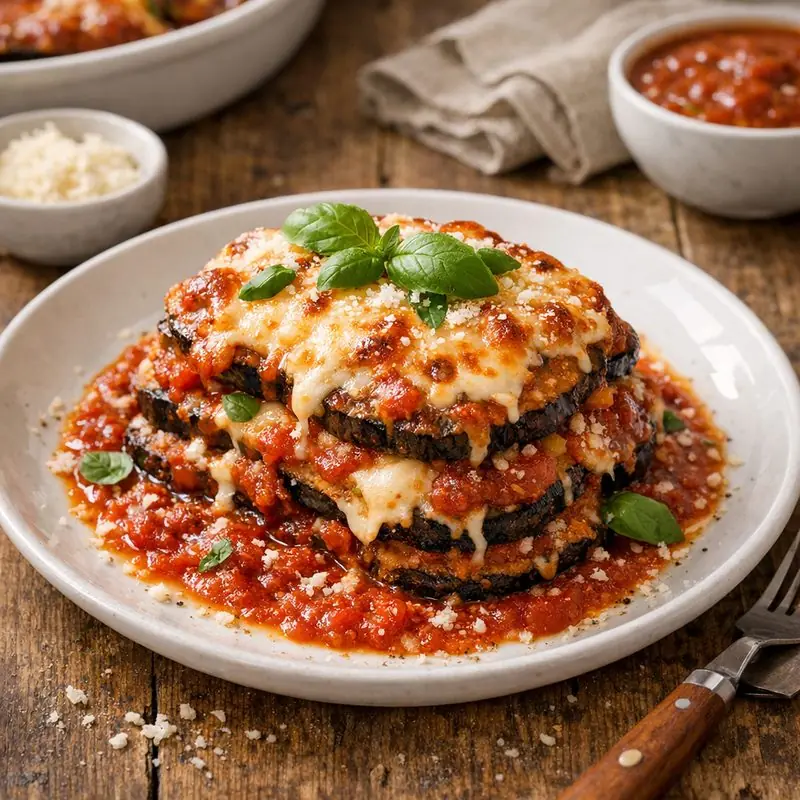
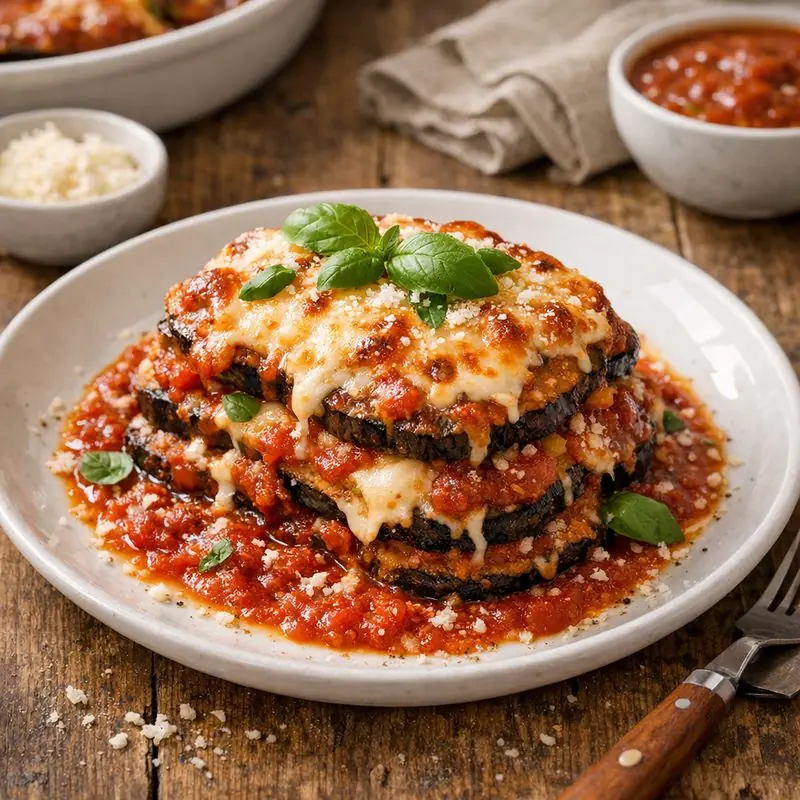
Classic Eggplant Parmesan is a baked Italian-American casserole of golden, breadcrumb-crusted eggplant slices layered with marinara and three cheeses. It takes about 1 hour and 45 minutes total — including salting time — and it suits vegetarians, meal preppers, and anyone who wants a deeply satisfying dinner that actually reheats beautifully.
- 2 large globe eggplants (about 2½ lbs total), sliced into ¼- to ⅓-inch rounds
- 1½ teaspoons kosher salt (Diamond Crystal; use 1 teaspoon if using Morton’s)
- 1½ cups Italian-seasoned breadcrumbs
- ½ cup finely grated Parmesan, divided (¼ cup for breadcrumbs, ¼ cup for topping; plus an additional ½ cup for assembly — 1 cup total)
- 3 large eggs, beaten
- ½ cup all-purpose flour
- ½ cup olive oil or neutral oil, for shallow frying (used in batches)
- One 28-oz can whole peeled San Marzano tomatoes, crushed by hand
- 3 garlic cloves, thinly sliced
- 2 tablespoons olive oil
- 1 teaspoon dried oregano
- Pinch of red pepper flakes
- Salt and black pepper to taste
- Small handful of fresh basil leaves, plus more for finishing
- 1 lb fresh mozzarella, sliced ¼-inch thick
- Slice the eggplants into rounds approximately ¼- to ⅓-inch thick. Lay them in a single layer on wire racks set over sheet pans. Sprinkle both sides generously with kosher salt and let them rest for at least 30 minutes (45 is better) until beads of moisture form on the surface.
- After resting, pat every eggplant slice firmly dry with paper towels — thorough drying is essential for a crispy crust.
- While the eggplant drains, make the marinara: warm 2 tablespoons olive oil in a medium saucepan over medium heat. Add the sliced garlic and cook until fragrant and barely golden, about 2 minutes. Add the red pepper flakes, then pour in the crushed tomatoes. Season with oregano, salt, and pepper. Simmer uncovered over medium-low heat for 20 to 25 minutes, stirring occasionally, until the sauce thickens and deepens in color. Remove from heat, stir in torn fresh basil, and adjust salt to taste.
- Set up a dredging station with three shallow bowls: flour (lightly seasoned with salt and pepper) in the first, beaten eggs in the second, and breadcrumbs mixed with ¼ cup grated Parmesan in the third.
- Working one slice at a time, dredge each eggplant round in flour (shake off excess), dip in egg, then press firmly into the breadcrumb mixture on both sides. Place breaded slices on a clean rack as you go.
- Pour enough olive oil into a large heavy skillet (cast iron or stainless) to come about ¼ inch up the sides. Heat over medium-high until the oil shimmers and a dropped breadcrumb sizzles immediately. Fry eggplant slices in batches without crowding, 2 to 3 minutes per side, until deep golden brown. Transfer to a paper-towel-lined rack to drain. Add oil between batches as needed and allow the oil to return to temperature before each new batch.
- Preheat the oven to 375°F.
- Spread a thin layer of marinara across the bottom of a 9×13 baking dish. Arrange a single layer of fried eggplant slices over the sauce, overlapping slightly if needed. Spoon a generous layer of marinara over the eggplant, then lay slices of mozzarella evenly across the top. Repeat the layers — eggplant, sauce, mozzarella — until all ingredients are used. Finish with a final layer of sauce and an even shower of the remaining grated Parmesan (about ½ cup).
- Cover the dish tightly with aluminum foil and bake for 25 minutes. Remove the foil and continue baking for another 20 to 25 minutes, until the top is golden, bubbling, and the Parmesan has formed a lightly crunchy crust.
- Let the casserole rest for 10 minutes before slicing. Scatter fresh basil over the top and serve with crusty bread and a simple green salad.
What sets this version apart is the salting step and a double-dredge that keeps the crust genuinely crispy even after baking under a blanket of sauce and mozzarella. Too many eggplant parmesan recipes skip the technique that matters most: drawing moisture out of the eggplant before it ever touches oil. Skip that step and you get a soggy, oil-soaked interior that no amount of good cheese can rescue. Do it right and you get slices that hold their structure through the whole bake, with a crust that stays just slightly textured against the creamy, molten cheese on top.
The flavor? It’s everything a great comfort dish should be. The eggplant turns sweet and tender inside. The marinara — reduced a little longer than you’d think — becomes deeply savory and concentrated. The mozzarella melts into glossy, pull-apart pools, and a shower of freshly grated Parmesan on top goes golden and nutty at the edges. It smells like a Sunday dinner at a good Italian restaurant. Serve it with crusty bread and a simple green salad, and nothing else is needed.
Why You’ll Love This Eggplant Parmesan Recipe
- Genuinely crispy crust: The double-dredge and salting method solves the sogginess problem that plagues most versions.
- Outstanding for meal prep: It reheats better than almost any other casserole — the layers actually improve overnight as everything melds together.
- Completely vegetarian: Hearty enough that meat-eaters won’t miss a thing.
- Make-ahead friendly: You can assemble it up to a day ahead, refrigerate it unbaked, and slide it into the oven when you’re ready.
- Flexible serving options: Serve it as a standalone entrée, over pasta, or tucked into a hoagie roll for an eggplant parm sandwich the next day.
What You’ll Need
These ingredients are straightforward, but a few of them deserve a closer look before you shop.
For the Eggplant
- 2 large globe eggplants (about 2½ lbs total) — Globe eggplant is the classic choice here. It’s wide enough to give you substantial slices. Look for firm eggplants with taut, shiny skin and no soft spots. Smaller, denser eggplants tend to have fewer seeds and milder flavor.
- 1½ teaspoons kosher salt — For drawing out moisture. Diamond Crystal is preferred; if you use Morton’s, reduce to 1 teaspoon.
- 1½ cups Italian-seasoned breadcrumbs — These provide the base flavor for the crust. Panko alone won’t hold together as well for this application.
- ½ cup finely grated Parmesan, divided — Mix some into the breadcrumbs; reserve the rest for the top layer.
- 3 large eggs, beaten
- ½ cup all-purpose flour — The first layer of the dredge. It helps the egg adhere, which helps the breadcrumbs stick. Don’t skip it.
- Olive oil or neutral oil for frying — About ½ cup, used in batches. You don’t need to deep-fry; a shallow fry in a skillet is enough.
For the Sauce
- One 28-oz can whole peeled San Marzano tomatoes — Crush them by hand directly into the pan. San Marzanos are sweeter and less acidic than standard canned tomatoes, which matters here since the sauce needs to be balanced, not sharp.
- 3 garlic cloves, thinly sliced
- 2 tablespoons olive oil
- 1 teaspoon dried oregano
- Pinch of red pepper flakes
- Salt and black pepper to taste
- Small handful of fresh basil leaves
For the Assembly
- 1 lb fresh mozzarella, sliced ¼-inch thick — Fresh mozzarella gives you those dramatic melt pools. If you use low-moisture shredded mozzarella, the texture will be drier and stringier, but it’ll work fine if that’s what you have.
- ½ cup finely grated Parmesan
- Fresh basil for finishing
Substitution notes: If you want a lighter version, you can bake the breaded eggplant slices at 425°F on an oiled wire rack instead of pan-frying. They won’t be quite as golden or crispy, but they’ll still hold up well in the layers. For a gluten-free version, use a GF flour blend and GF breadcrumbs — the technique is identical. If you love this dish, you’ll also enjoy creamy baked ziti, which uses a similar layering approach with pasta.
How to Make Classic Eggplant Parmesan
Step 1: Salt and Drain the Eggplant (30–45 minutes, mostly hands-off)
Slice the eggplants into rounds approximately ¼-inch to ⅓-inch thick. Lay them in a single layer on wire racks set over sheet pans, or in a colander. Sprinkle both sides generously with kosher salt. Let them sit for at least 30 minutes — 45 is better.
You’ll see beads of liquid form on the surface. That’s the goal. The salt draws out moisture through osmosis, which accomplishes two things: it concentrates the eggplant’s flavor and dramatically reduces the amount of oil the slices will absorb during frying. After the resting time, pat every slice firmly dry with paper towels. This step is non-negotiable — surface moisture is the enemy of a crispy crust.
Step 2: Make the Marinara
While the eggplant is draining, start the sauce. Warm 2 tablespoons of olive oil in a medium saucepan over medium heat. Add the sliced garlic and cook until fragrant and just barely golden, about 2 minutes — watch it carefully, because bitter garlic will ruin the whole sauce.
Add the red pepper flakes, then pour in the crushed tomatoes. Season with oregano, salt, and pepper. Bring to a simmer, reduce the heat to medium-low, and cook uncovered for 20 to 25 minutes, stirring occasionally, until the sauce thickens noticeably and the color deepens from bright red to a richer, slightly darker hue. Remove from heat and stir in torn fresh basil. Taste and adjust salt. A good sauce should taste just slightly more concentrated than you’d want on its own — it’ll mellow once it’s baked into the casserole.
Step 3: Set Up Your Dredging Station
Set up three shallow bowls in a row: flour in the first, beaten eggs in the second, and breadcrumbs mixed with ¼ cup of the grated Parmesan in the third. Season the flour lightly with salt and pepper.
Working one slice at a time, dredge each piece in flour (shake off the excess — a light coat is enough), dip in egg, and press firmly into the breadcrumb mixture on both sides. The pressing matters: breadcrumbs that are loosely stuck will fall off in the oil. Place the breaded slices on a clean rack as you go.
Step 4: Fry the Eggplant in Batches
Pour enough olive oil into a large, heavy skillet — cast iron or stainless steel — to come about ¼ inch up the sides. Heat over medium-high until the oil shimmers and a breadcrumb dropped in sizzles immediately. That’s your cue to start frying.
Fry the slices in batches, leaving space between them. Crowding the pan drops the oil temperature, which causes the eggplant to absorb oil and steam instead of crisp. Cook 2 to 3 minutes per side until deep golden brown. Transfer to a paper-towel-lined rack and let them drain. Add oil between batches as needed, and let the oil return to temperature before adding the next round. The finished slices should be firm, golden, and fragrant — not floppy.
Step 5: Assemble the Layers
Preheat your oven to 375°F. Spread a thin layer of marinara across the bottom of a 9×13 baking dish — just enough to prevent the bottom layer from sticking and drying out.
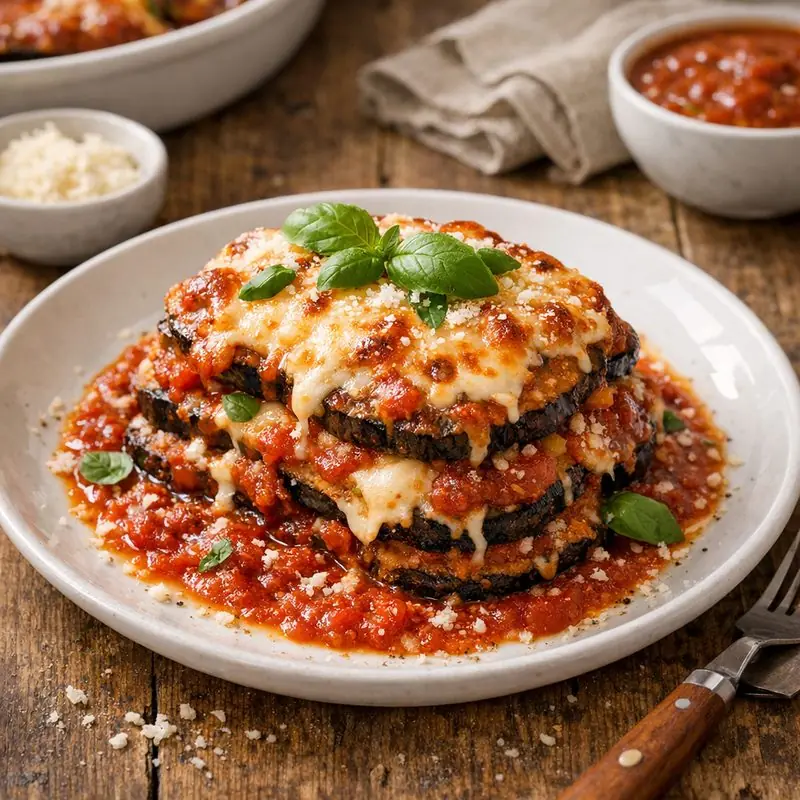
Arrange a single layer of fried eggplant slices over the sauce, overlapping slightly if needed to fit. Spoon a generous layer of marinara over the eggplant, then lay slices of mozzarella evenly across the top. Repeat the layers: eggplant, sauce, mozzarella. Finish the top with a final layer of sauce and an even shower of the remaining grated Parmesan. The Parmesan on top will form a golden, slightly crunchy crust as it bakes — that’s the goal.
Step 6: Bake
Cover the dish tightly with aluminum foil and bake for 25 minutes. Remove the foil and continue baking for another 20 to 25 minutes, until the top is golden and bubbling at the edges and the cheese has gone from melted to beautifully caramelized in spots. Let the dish rest for 10 to 15 minutes before cutting — this is essential. Cutting too early causes the layers to slide apart and the cheese to run everywhere. The rest time lets everything set into clean, cohesive slices.
Scatter fresh basil over the top just before serving. If you enjoy building Italian casseroles like this one, you’ll also want to try homemade meat lasagna — the layering technique is very similar.
Tips, Variations & Serving Ideas
Make-Ahead Instructions
This eggplant parmesan recipe is an excellent make-ahead dish. You can fully assemble the unbaked casserole, cover it tightly with foil, and refrigerate it for up to 24 hours before baking. Add 10 minutes to the covered baking time if going straight from the refrigerator to the oven. The assembled and baked dish also keeps well, refrigerated and tightly covered, for up to 4 days. Many people find the flavor improves significantly on day two.
Storage and Reheating
Store leftovers in an airtight container in the refrigerator. To reheat, place portions in a 350°F oven for 15 to 20 minutes until heated through. The oven — not the microwave — is the right tool here. The microwave will make the crust soggy and unevenly heated. For meal prep purposes, portion the cooled casserole into individual containers before refrigerating so it’s grab-and-go all week. Pair with simple garlic roasted broccoli for a full balanced meal prep spread.
Variations Worth Trying
- Baked (not fried) version: Spray the breaded slices with olive oil cooking spray and bake on a wire rack at 425°F for 20 to 22 minutes, flipping once. The crust won’t be quite as golden or sturdy, but it’s a reasonable lighter option.
- Add a ricotta layer: Spread a thin layer of whole-milk ricotta between the eggplant and mozzarella in each layer. It makes the dish richer and creamier — closer to a vegetable lasagna texture.
- Spicy version: Double the red pepper flakes in the sauce and add a pinch of Calabrian chili paste.
- Eggplant parm sandwich: Leftover slices make extraordinary sandwiches on toasted hoagie rolls with extra marinara and a broiled layer of provolone.
Serving Suggestions
Classic eggplant parmesan is rich enough to stand alone as an entrée. A simple green salad dressed with lemon and olive oil cuts through the richness beautifully. Crusty Italian bread for sauce-scooping is essentially mandatory. If you want to serve it over pasta, a simple spaghetti aglio e olio underneath works perfectly — the marinara from the casserole acts as the sauce. For a lighter pairing, try lemon herb white bean salad alongside it.
Common Mistakes and How to Fix Them
Soggy, Oil-Soaked Eggplant
Problem: The finished slices are greasy and soft instead of firm and golden.
Fix: This is almost always caused by skipping or rushing the salting step, or frying at too low a temperature. Eggplant is a sponge — without salting, it absorbs oil like a sponge dropped in a puddle. Make sure the oil is hot enough before each batch (a breadcrumb should sizzle on contact), and don’t overcrowd the pan.
Crust Falls Off During Frying
Problem: The breadcrumb coating separates and slides off in the oil.
Fix: This happens when the flour coat is too thick (trapping steam under the crust) or when the breadcrumbs weren’t pressed firmly enough. Shake off excess flour vigorously, and after pressing into the breadcrumbs, give each slice a gentle but firm pat on both sides. Let the breaded slices rest on a rack for 5 minutes before frying — this helps the coating adhere.
Watery, Thin Layers
Problem: The finished casserole is watery and the layers slide apart when cut.
Fix: Two culprits: the sauce wasn’t reduced enough before assembly, and the dish wasn’t rested before cutting. The sauce should be thick enough to hold its shape on a spoon. And always allow a full 10 to 15 minutes of resting after baking — the internal temperature evens out and the layers firm up considerably.
Bitter-Tasting Eggplant
Problem: There’s an unpleasant bitterness in the finished dish.
Fix: Older, larger eggplants with lots of seeds tend to be more bitter. The salting step does help reduce this, but the best prevention is choosing fresh, firm eggplants that feel heavy for their size, and using them within a few days of purchase. If bitterness is an issue, peel the eggplant completely — most of the bitter compounds concentrate near the skin. Also check that you didn’t let the garlic in the sauce go past golden, as bitter garlic will make the whole sauce taste off. For more tips on building vegetable-forward Italian dishes, check out roasted vegetable pasta bake.
You May Also Like


Frequently Asked Questions About Eggplant Parmesan
Do you have to peel the eggplant for eggplant parmesan?
You don’t have to, and most traditional recipes leave the skin on. The skin softens significantly during frying and baking, so it’s rarely tough or unpleasant in the finished dish. That said, if you’re working with very large, mature eggplants whose skin is thick and chewy, peeling is a good call. For medium-sized, fresh eggplants, leave the skin — it helps the slices hold their shape through frying.
Can you make eggplant parmesan without frying?
Yes. Baking the breaded slices is a popular lighter alternative. Spray them generously with olive oil cooking spray, place on a wire rack set over a sheet pan, and bake at 425°F for about 20 minutes, flipping halfway through. The result is less golden and slightly less crispy than pan-fried slices, but the casserole will still be delicious. The key is using the wire rack — baking directly on the pan causes the bottom to steam instead of crisp.
How do you keep eggplant parmesan from getting soggy?
Three things matter most: salt the eggplant slices and pat them completely dry before breading, fry at the right oil temperature (hot enough to sizzle immediately), and use a thick, well-reduced marinara sauce. Watery sauce is the most common culprit in soggy casseroles. Simmer your sauce until it noticeably thickens and mounds on a spoon before assembling the layers.
Can you freeze eggplant parmesan?
Yes, and it freezes very well. You can freeze it either before or after baking. For best results, assemble the casserole, let it cool completely if already baked, cover tightly with plastic wrap and then foil, and freeze for up to 3 months. Thaw overnight in the refrigerator before reheating in a 350°F oven, covered, for 25 to 30 minutes. The texture after freezing and reheating is slightly softer, but the flavor is excellent — which makes it a great batch-cooking project.
What’s the best type of eggplant to use for eggplant parmesan?
Globe eggplant — the large, dark purple variety most commonly found in US grocery stores — is the classic and best choice. Its wide diameter gives you substantial, meal-worthy slices. Italian eggplant (slightly smaller and more elongated) is also excellent and tends to have fewer seeds and a slightly sweeter flavor. Avoid Japanese or Chinese eggplant for this recipe; they’re too narrow to yield useful slices for a layered casserole.
Ready to Make It?
Classic eggplant parmesan is one of those recipes that rewards patience. The salting step, the proper fry temperature, the reduced sauce — none of it is complicated, but each step is doing real work. Put it all together and what comes out of the oven is genuinely impressive: golden, bubbling, fragrant with basil and garlic, with layers that hold beautifully when you cut into them. It’s the kind of dish that makes the kitchen smell incredible for hours.
Give it a try this week — it’s especially good for a Sunday cook that sets you up with leftovers through Wednesday. If you make it, leave a comment below and let us know how it went. And save this recipe to your Pinterest board so it’s easy to find the next time you need a knockout vegetarian dinner.
Note: photos on this site are AI-generated illustrations of the finished dish. Recipes are developed from established cooking techniques; adjust seasoning and doneness to taste.